Science & Innovation: Ghana’s Kuntunse Radio Telescope Puts Nation on Global Astronomy Map
Kuntunse, Accra – January 24, 2026
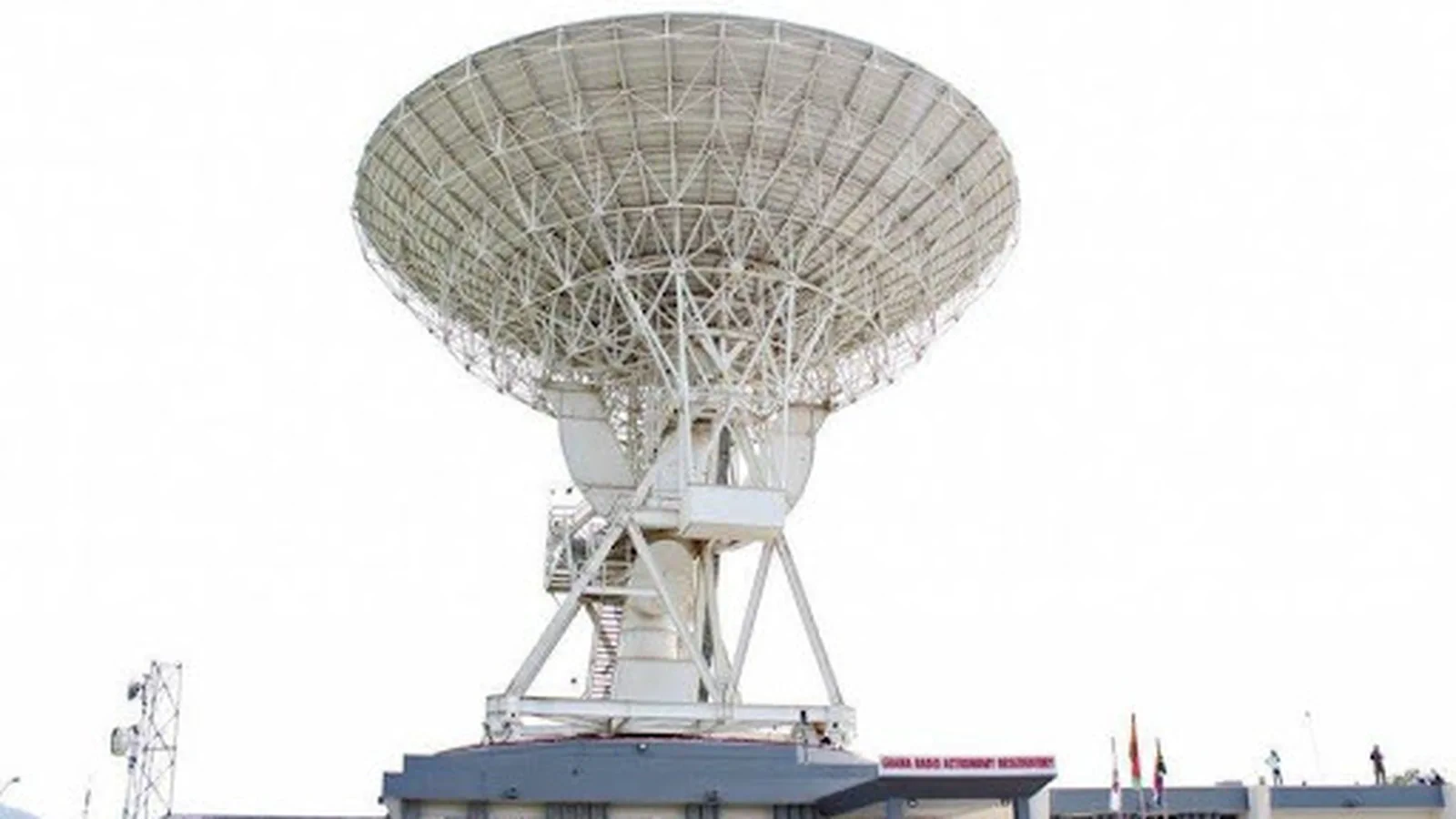
Ghana’s Radio Astronomy Observatory at Kuntunse, near Accra, is drawing growing international attention as a centre for scientific discovery, innovation, and capacity building in space science. The facility, home to a 32-metre radio telescope, has become a cornerstone of Ghana’s expanding presence on the global astronomy stage.
The observatory was established through the conversion of the former Ghana Satellite Earth Station into a functioning radio astronomy instrument. Today, the Kuntunse Radio Telescope detects faint radio waves emitted by celestial objects such as pulsars and interstellar gases, enabling scientists to study the structure and dynamics of the universe.
Strategic Location and Scientific Advantage
Astronomers note that Kuntunse’s location close to the equator provides a major scientific advantage, allowing the telescope to observe nearly the entire sky. This near-complete sky coverage makes it especially valuable for studies of the Milky Way and distant cosmic phenomena.
In recent years, the facility has achieved several significant milestones. It became the first operational radio telescope in West Africa to be integrated into the African Very Long Baseline Interferometry Network (AVN), a continental collaboration that links radio telescopes across Africa to function as a single, high-resolution scientific instrument.
Ghana’s successful “first light” observations included the detection of methanol masers and ongoing pulsar monitoring, confirming the telescope’s operational readiness and scientific capability.
Building Local Capacity in Space Science
Beyond research, the Kuntunse Observatory plays a critical role in developing Ghana’s scientific workforce. In August 2025, the facility hosted the Transient Array Radio Telescope (TART) workshop, which trained students, technicians, and scientists in building, calibrating, and operating modular radio telescopes.
Officials say these hands-on skills are helping to broaden local expertise in physics, engineering, and data analysis, while also making astronomy more accessible as a tool for education and innovation.
Economic and Educational Potential
Government scientists and researchers highlight the observatory’s long-term economic and educational benefits. The project is expected to create employment opportunities in areas such as information and communication technology, engineering, data science, and scientific tourism, contributing to Ghana’s knowledge-based economy for decades to come.
Challenges and Site Protection
Despite its successes, the observatory faces operational challenges. Encroachment from nearby settlements has increasingly threatened its ability to operate without interference, as radio astronomy instruments are highly sensitive to radio frequency noise.
Scientists have therefore called for stronger protection of the site to safeguard Ghana’s investment in space science and ensure uninterrupted research activities.
A Symbol of Innovation
As Ghana deepens its participation in international science partnerships and radio astronomy networks, the Kuntunse Radio Telescope stands as a powerful symbol of innovation. It represents a bridge between local scientific ambition and humanity’s broader quest to explore and understand the universe.